

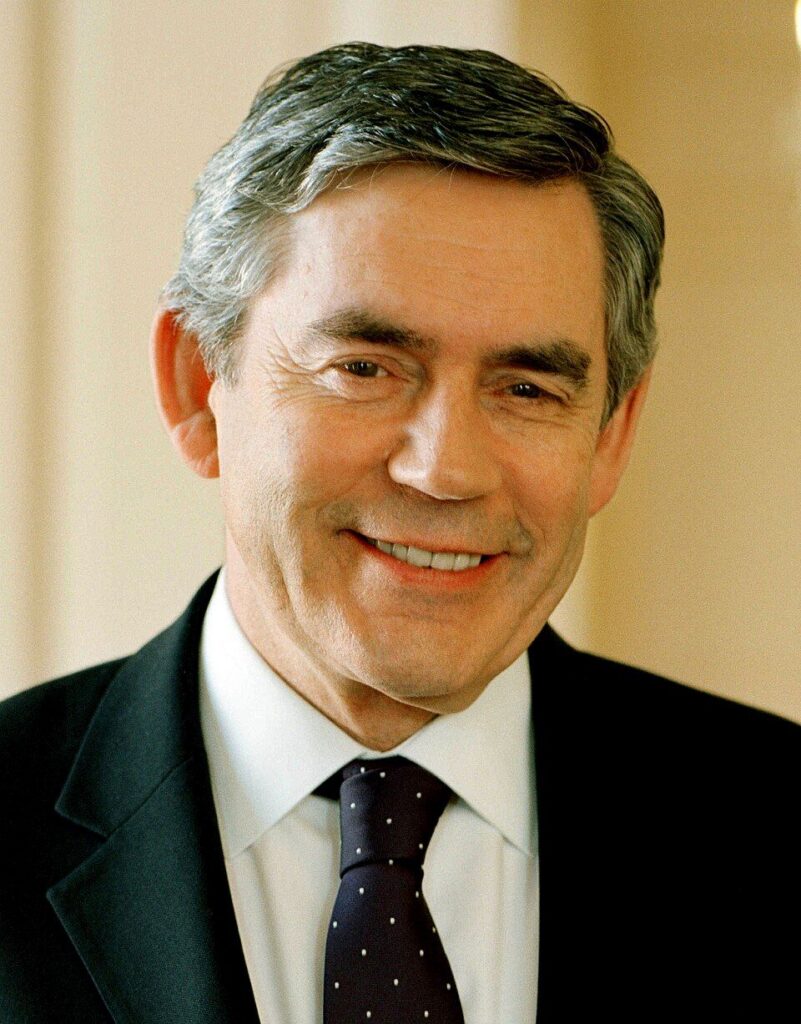
Gordon Brown’s new book, The Future Starts With Us, rests on a simple idea: the repair of a broken world begins in the village hall. It draws on a survey of 100,000 people in 34 countries. Speaking to Alastair Campbell this week, Brown said people sense two crises at once: a collapsing world order and what he calls a “civic recession”. The second, he argues, may be the key to the first.
The need to rebuild civic society
The survey turned up something Brown says he did not expect. Beneath the familiar complaints about trust, nostalgia and immigration, people feel a strong sense of civic decline, and no one to turn to when they are in trouble. The numbers are stark. The Women’s Institute has fallen from a million members to under half a million, and working men’s clubs from four million to one million. Some 45 per cent of Britons belong to nothing at all, not even a sports club.
The finding that matters most is that people active in their communities, especially across ethnic and religious lines, are the most likely to resist populist nationalism and to back international cooperation. The local, in other words, feeds the global.
Brown’s remedies are practical. He notes that if roads or banks failed there would be panic, yet civic infrastructure is crumbling unnoticed. Recruitment matters, he says, and he cites wartime resistance fighters, who mostly joined because someone they respected asked them to. He also wants better public spaces than the draughty old hall, and thinks the internet can lead people to face-to-face meetings. A Facebook group in his hometown of Kirkcaldy has 50,000 to 60,000 members, more than the town’s population.
For young people, he suggests an Erasmus-style exchange between Scots, English, Welsh and Irish, and optional community service. A million 16-to-25-year-olds are not working, and he warns that a generation with no faith group, little civic education and few jobs “is not a good society”.
The need to replace the loss of American leadership
Brown describes three seismic shifts. America is no longer the hegemonic power, and the world is multipolar. Free trade has given way to protectionism. And a rules-based order is yielding to a power-based one, in which Trump, Putin, Xi, Modi and Erdogan see the world as zero-sum. There are about 65 conflicts worldwide, the most since 1946. He stresses that American strain is “a long-term factor”, not just a Trump problem. Twenty years ago, he suggests, Putin would not have dared invade Ukraine.
His answer, closer to Mark Carney’s thinking than to nostalgia, is a coalition of countries that are neither Washington nor Beijing. It would rest on seven principles for a new global charter, including human dignity, the rule of law, sovereign equality and shared responsibility for global risks. The UN Charter remains central, he says, but it never addressed climate change, terrorism or the changed relationship between north and south.
Crucially, he says this cannot be a European club. It must be “global North plus global South”, and he is already talking to African leaders, with Korea and Japan interested. He does not rule out America joining, noting that Trump’s talk of reciprocity could point towards fair trade. He also cannot resist an anecdote: Trump, he says, once explained his Greenland ambitions as a property developer who loves maps, apparently misled by a projection that makes it look the size of Africa.
The urgency is nuclear. Fear of war now tops the global worry list. If America’s shelter looks unreliable, Brown warns, Korea, Japan, Saudi Arabia, Turkey, Poland and others may seek their own weapons, taking nine nuclear states to nearly twenty. He adds a study from King’s College in which AI systems asked to handle a dispute between countries escalated to nuclear strikes 95 per cent of the time. Yet his polling finds 57 per cent worldwide, and about 60 per cent in America and Europe, willing to compromise national interest to cooperate.
The need to make the economy work again
Brown insists that civic renewal cannot succeed without fixing living standards. People were taught that each generation would do better than the last, and many no longer believe it. He defends his record but concedes that globalisation was never properly managed, and says austerity was a mistake that left Britain with a decade of growth around one per cent.
His prescription is growth through innovation. Britain starts companies well but loses them when they need to scale, and entrepreneur Hermann Hauser says the last twelve unicorns he backed all went to America. Brown wants a European-wide capital market and British access to European scale-up funds. Only 36 per cent of Britons believe their country leads in science. He thinks Britain should be “the innovation nation”.
The long view
Brown ends where he began, with ideas over personalities. Politics, he says, is not the art of the possible but “trying to make the desirable possible”. On the evidence of this interview, he has not lost the habit.