

Report of a talk to Labour International CLP, 13 October 2026
Sir John Curtice does not do soft soap. Addressing Labour International CLP on 13 October, the country’s best-known electoral analyst warned members at the outset that his talk would be a critical evaluation, and he delivered exactly that: a reminder of how close Labour came to the cliff-edge this spring, an honest account of why it has partly recovered, and a sobering look at the deeper currents that pose structural risk for the next general election.
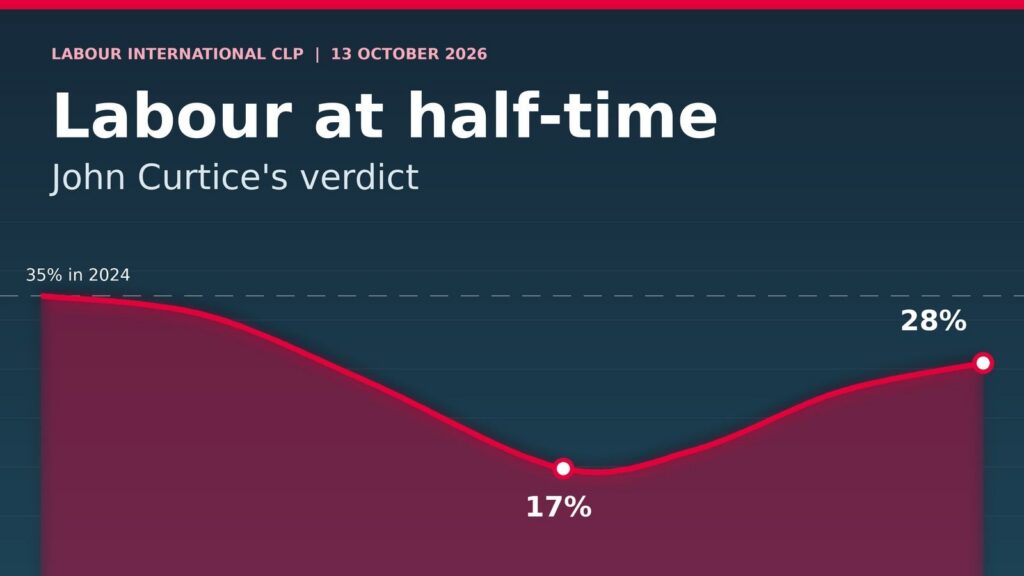
The May wipe-out
Curtice began with 7 May, a night whose scale he believes has been underappreciated. Outside London, Labour defended around 1,400 council seats and lost 1,000 of them. Its vote fell by between 13 and 20 points whatever baseline you choose, and the BBC’s projected national share put the party on just 17%. Even in London, where seat losses were smaller, it was Labour’s worst borough result since the councils were created in 1964. In Wales the party’s share was the lowest since 1906; in Scotland you have to go back to 1910 (leaving aside the unusual 2019 European election). Reform took around a quarter of the vote and 1,300 seats, while the Greens advanced by about ten points. After the Makerfield by-election, Keir Starmer’s departure was, in Curtice’s view, hardly surprising.
The Burnham bounce: real, but measured and typical
Things have improved since then. Labour stood at 19% when Keir Starmer announced his resignation; it is now around 28%, five points clear of a fading Reform, though still seven points below its modest 35% in 2024. (Curtice reminded the room: Starmer never won a landslide.) Andy Burnham’s net favourability is plus seven, against Starmer’s minus 50 a year ago.
But Curtice was careful not to overstate the nature of the upturn in fortunes – or its mutability. Gordon Brown and Boris Johnson enjoyed similar bounces on taking over mid-term; only Liz Truss missed out. More revealing is where the recovery has come from. Labour has stemmed its losses to the Greens and Liberal Democrats and won some of their voters back, in effect reuniting the progressive bloc. It has made almost no inroads among those who left for Reform: the roughly one in ten 2024 voters lost to Reform now looks irreverable. This tends to support those in LI who argued the pointlessness and danger of pandering to Reform voters and, by so doing, alienating and losing natural supporters to the Greens and Lib-Dems.
Delivery still decides votes
The short-term test is performance in office. Among 2024 Labour voters who thought the economy was getting a lot worse, only 26% planned to stick with the party; among the minority who thought it was improving, three-quarters did. The NHS shows the same pattern. Perceptions of the government’s handling of both have improved, but most of that progress came under Starmer, and even among Labour’s own 2024 voters more say the economy is being handled badly than well. Without movement here, Curtice doubts Labour can get back to 35% any time soon, and economic discontent drives losses to Reform as well as to the left.
A changed map of British politics
The bigger story is structural. Politics now runs on two independent axes: the familiar left–right economic divide, and a social liberal versus social conservative one. Reform voters, overwhelmingly Leave supporters, are defined less by right-wing economics (they are less hostile to inheritance tax than Conservative voters) than by social conservatism. In 2001 Labour polled almost as well among social conservatives as social liberals; today its vote is sharply skewed towards social liberals. The Starmer–McSweeney strategy of winning back working-class Leave voters made little headway, and only 15% of Labour’s current support comes from people who would vote to stay out of the EU. Burnham, Curtice observed, is following the Labour vote rather than leading it.
Demography has shifted too. Age, not class, is now the key dividing line. Labour’s core is young, middle-class professionals, strongest in London, and that is precisely the group the Greens are courting. The angst about the Red Wall is somewhat outdated: Reform is now the most popular party among working-class voters.
First past the post is no longer a safe bet
Four recent MRP mega-polls put Labour on only 250–270 seats, short of a majority even with Liberal Democrat support, potentially handing the Greens and the SNP real leverage. Crucially, Labour is losing most ground where it was previously strongest, just as the Conservatives did in 2024 when they ended up with 120 seats rather than 240. That pattern under the current voting system exaggerates seat losses, and Reform is the beneficiary. Nor, despite the “borrowed votes” of 2024 is tactical voting a reliable safety net: Green and Liberal Democrat supporters are only slightly more willing to back Labour against Reform than against the Conservatives, and May’s council results showed little sign of anti-Reform tactical voting. Curtice left members with an open question: does first past the post still serve Labour’s interests?
On Europe, he was more encouraging. Polls this year put support for rejoining the EU at 61%, an all-time high, and Labour’s current voters are roughly 85% Remain. A warmer stance on Europe carries less risk in Leave-voting seats than is often assumed.
What Labour should do before the end of this parliament
The message for the remaining years of the term is clear. Labour must turn improved leadership ratings into visible delivery, above all on the cost of living, the economy and NHS waiting times, because those judgements move votes in every direction. It should consolidate the progressive bloc rather than chase a Leave-voting working-class coalition that has moved on, accepting that its core is now younger, socially liberal and urban, and competing hard with the Greens for it. It can afford to be bolder on closer relations with Europe. It should not count on tactical voting to save marginal seats, and should plan for a hung parliament in which the Greens, the Liberal Democrats and the SNP may hold the balance. Burnham is wise not to rush to the country. And with first past the post now amplifying Labour’s losses, the party has every reason to begin a serious internal conversation about electoral reform before, rather than after, the next election.
If there is a message: the threat to the country is real; be bold and be Labour.